
System Excellence
System Excellence
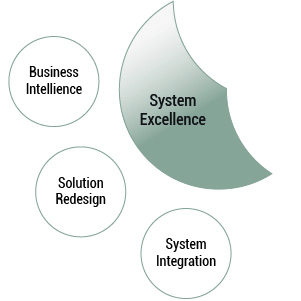
Optimization and streamlining of HR processes and systems to improve overall efficiency, accuracy and effectiveness.
It involves a review of the current HR system and its effectiveness in delivering HR services, followed by implementation of best practices, process improvements, and technology integration to enhance efficiency, productivity and employee satisfaction.
It includes business intelligence and data analytics, business process reengineering, system integration, automation of HR processes, and the adoption of modern HR technologies such as Artificial Intelligence and Machine Learning.
Business Intelligence
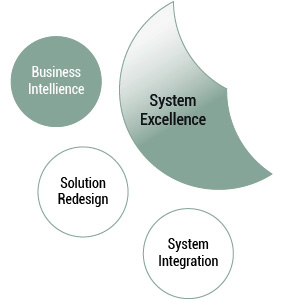
Enabling HR stakeholders to access data analytics from multiple systems and sources using technology to make better decisions to improve performance within an organization.
- Collecting data: This involves gathering information from various sources, such as sales reports, customer feedback, and market trends.
- Cleaning and organizing data: Once data has been collected, it needs to be cleaned up and put into a format that makes sense. Standardization of HR data across all systems, ensuring data consistency and accuracy.
- Analyzing data: This involves looking at the data to find patterns, make predictions, and identify trends.
- Visualizing data: Data is often easier to understand when it is presented in a visual format, such as a graph or chart.
- Sharing insights: Once the data has been analyzed and visualized, the insights can be shared with decision-makers in the company, who can use them to make informed decisions.
Artificial Intelligence (AI) and Machine Learning (ML) are rapidly becoming an integral part of business intelligence and data analytics. These technologies can be used to automate tasks such as data cleaning and preprocessing, and to build predictive models that can be used to drive business decisions.
Process Reengineering
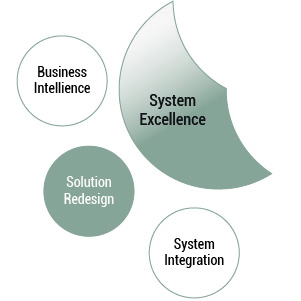
Process of evaluating and redesigning HR processes to make them more efficient, effective, and aligned with the overall goals of the organization.
- Identifying and mapping HR processes: The first step is to understand the current HR processes, including the tasks involved, people involved, tools used, and the flow of information.
- Assessing and optimizing processes: Once the processes have been identified and mapped, they can be evaluated to determine areas for improvement. This may involve streamlining processes, reducing cycle time, and reducing manual effort.
- Automating HR processes: Automating HR processes can help to reduce manual effort, improve data accuracy, and speed up HR processes. This can be achieved by implementing HR information systems, workflow automation tools, and other technology solutions.
- Enhancing collaboration: BPR in HR can also help to enhance collaboration between HR and other departments in the organization, as well as between HR and employees. This can be achieved by implementing processes that encourage collaboration, communication, and knowledge sharing.
- Measuring success: It's important to track the progress and impact of BPR initiatives, and to use this information to make further improvements. Key performance indicators (KPIs) such as process cycle time, error rate, and employee satisfaction can be used to measure success.
System Integration
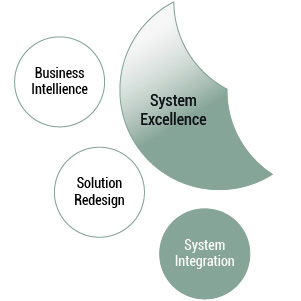
Increased efficiency and reduced costs by eliminating duplicative systems and processes and enabling more effective use of HR technology and resources.
- Integration of HR systems with other key business systems, such as talent acquisition, learning and development, performance management, payroll, time and attendance, and benefits administration.
- Automation of manual HR processes, such as data entry and data reporting, to improve efficiency and reduce errors.
- Self-service portals: Providing employees with a single point of access to HR information and services through a self-service portal. This portal can be integrated with other business systems, such as payroll and benefits administration systems. +
- Mobile integration: Making HR systems and services accessible to employees through mobile devices, to provide them with convenient and flexible access to information and services, regardless of location.
- Enhancing the overall user experience by providing a seamless, integrated platform for HR information and processes.
- Improved data security by centralizing HR data in a single system and implementing appropriate data access controls.